

The Andean worldview is one of the most profound and complex systems of thought developed by pre-Hispanic civilizations in South America. For the Incas, the universe was not a chaotic space nor one dominated by human beings, but a living, ordered, and sacred whole in which every element fulfilled an essential role. Nature, gods, ancestors, and people were closely interconnected within a network of balance that had to be respected to ensure harmony and the continuity of life.
Understanding the Andean worldview allows us to go beyond archaeological monuments and grasp the spiritual logic that shaped the Inca Empire. Many of these beliefs did not disappear with the Spanish conquest; instead, they remain alive today in Andean communities, blended with modern religious practices and ancestral traditions.
What Is the Andean Worldview?
The Andean worldview refers to the way Andean peoples explained the origin of the world, the functioning of the universe, and the relationship between humans and nature. Unlike Western perspectives, this conception does not place humans at the absolute center, but rather as part of a larger system that includes mountains, rivers, animals, celestial bodies, and invisible forces.
For the Incas, everything possessed life and spirit. Mountains, known as apus, were protective beings; the earth, called Pachamama, was a generous yet demanding mother; and the sun, Inti, represented the vital energy that sustained the empire. Living in balance with these forces was essential to ensure good harvests, health, and social stability.
You may also be interested in: Iconic places to visit in Peru you can’t miss

The Three Worlds of the Andean Worldview
One of the central pillars of the Andean worldview is the symbolic division of the universe into three interconnected levels or worlds, which coexisted and influenced one another.
Hanan Pacha: The Upper World
Hanan Pacha was the upper world, the realm of the gods and celestial bodies. Deities such as Inti (the sun), Mama Quilla (the moon), and other cosmic entities associated with universal order resided there. This world represented light, knowledge, and cosmic balance.
The Incas carefully observed the movements of the sun, moon, and stars, as these phenomena directly influenced agriculture and religious rituals.
Kay Pacha: The World of Here and Now
Kay Pacha was the earthly world, the space where humans, animals, and plants lived. This level represented the present, action, and daily life. In the Andean worldview, Kay Pacha was a place of learning, where people were expected to act with respect and reciprocity toward nature.
Uku Pacha: The Inner or Lower World
Uku Pacha was the inner or underground world, associated with ancestors, fertility, and the cycles of life and death. It was not considered a negative place, but rather one of transformation and renewal. From this world, life emerged—like seeds sprouting from the earth.
Pachamama: The Heart of the Andean Worldview
Within the Andean worldview, Pachamama holds a central place. She is not merely the physical earth, but a living deity who nourishes, protects, and sustains all beings. In return for her gifts, she demanded respect, care, and gratitude.
The Incas performed offerings to honor Pachamama, especially before planting, harvesting, or important events. These ceremonies sought to maintain balance between humans and nature, preventing disruptions that could lead to droughts, illness, or natural disasters.
Even today, many regions of the Andes continue to perform rituals of gratitude to Pachamama, demonstrating the continuity of this ancestral vision.
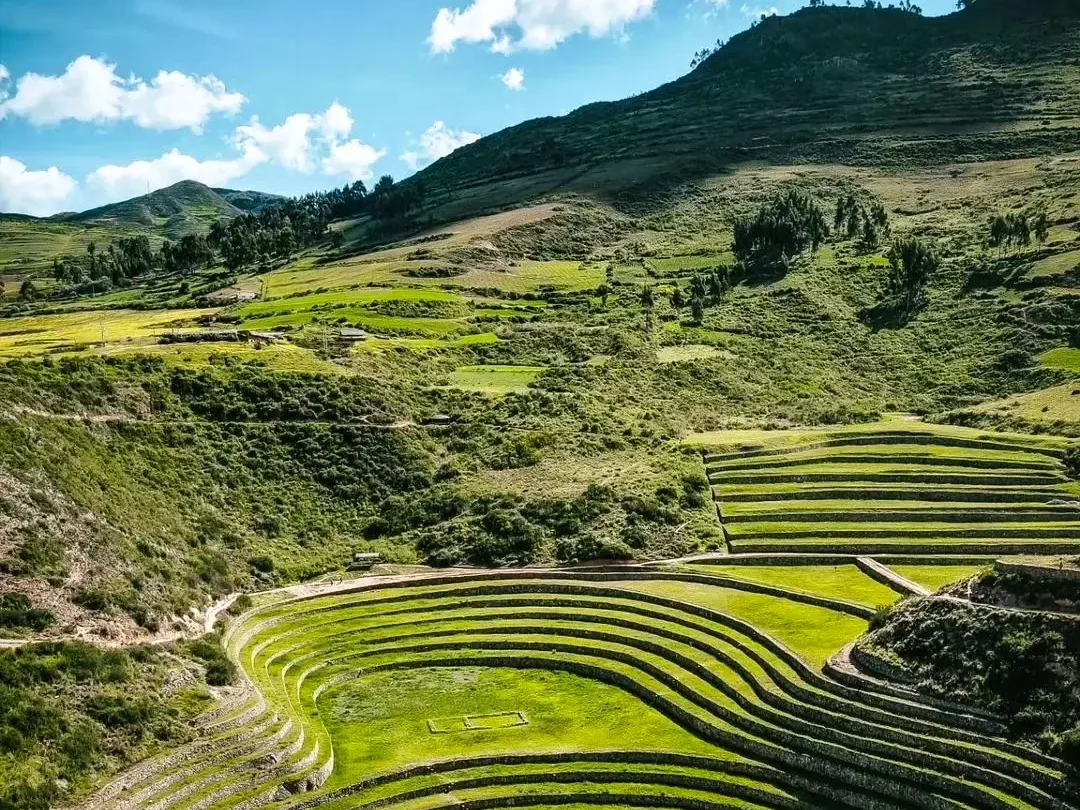
You may also be interested in: A traveler’s guide to Moray Peru history and culture

Inti and the Cult of the Sun
The god Inti was one of the most important deities of the Inca Empire. He represented the sun, vital energy, and cosmic order. The Inca ruler was considered the direct son of Inti, which legitimized his political and religious authority.
Sun worship was expressed through temples, rituals, and festivals such as Inti Raymi, a ceremony celebrating the winter solstice and marking the beginning of a new agricultural cycle. This event was one of the most significant within the Andean worldview, symbolizing the renewal of the bond between the gods and the people.
The Principle of Reciprocity: Ayni, Minka, and Mit’a
The Andean worldview was not limited to spirituality; it was also reflected in social organization. One of its fundamental values was reciprocity, expressed through three key concepts:
- Ayni: mutual aid between individuals or families
- Minka: communal work for collective benefit
- Mit’a: service to the state, especially in public works
These principles ensured social cohesion and reflected the idea that no one lives in isolation. Just as nature provides its resources, human beings were expected to restore balance through work and cooperation.
Inca Rituals and Ceremonies
Rituals were an essential part of the Andean worldview. Through ceremonies, the Incas sought to communicate with the gods, express gratitude for their gifts, and ask for protection.
Among the most important rituals were:
- Offerings of food, coca leaves, and symbolic objects
- Agricultural ceremonies linked to planting and harvest cycles
- Rites of passage, such as births, marriages, and funerals
These acts were not simple traditions, but profound expressions of the relationship between the spiritual and earthly worlds.
The Coca Leaf in the Andean Worldview
The coca leaf held sacred significance within the Andean worldview. It was used in religious rituals, community ceremonies, and as a means of communication with the gods and the apus.
Beyond its spiritual value, coca also served practical purposes, such as relieving fatigue and helping people cope with high altitudes. Its use was deeply integrated into both daily life and ritual practices of Andean societies.
The Apus: Spirits of the Mountains
Mountains were considered living and protective beings. Each community had guardian apus that watched over its well-being. In the Andean worldview, these entities controlled the climate, water sources, and the fertility of the land.
For this reason, many Inca cities—such as Cusco—were built in harmony with sacred geography and aligned with specific mountains, reinforcing the connection between the spiritual and the physical realms.
You may also be interested in: Things to do in Ayacucho for cultural travelers
The Andean Worldview Today
Although the Inca Empire disappeared centuries ago, the Andean worldview remains alive in many Andean communities. Rituals, beliefs, and ancestral values continue to be practiced, adapted to modern life.
This persistence shows that the Andean worldview is not merely a relic of the past, but a living system of thought that continues to offer lessons on balance, respect, and coexistence with nature.
The Andean worldview is a holistic vision of the universe that integrates spirituality, nature, and social organization. Through their beliefs and rituals, the Incas built a civilization deeply connected to its environment and grounded in balance and reciprocity.
Understanding this way of perceiving the world not only helps us better comprehend the history of the Inca Empire, but also appreciate a cultural legacy that still endures in the Andes—one that continues to inspire a more harmonious relationship between humans and nature.

