

You’ve surely heard of Peruvian folklore and our customs, but what defines Peru? I want to introduce you to the most popular cultural traditions in Peru but they go far beyond what you imagine. We are more than Machu Picchu and ceviche; we are a country where millennia of history converge, where each festival tells the story of our ancestors through dance. That’s why I invite you to discover the best of Peru and our ancestral traditions in this article, created for culture lovers like you.
Traditional Peru dances: The soul of the people
Traditional Peruvian dances are the beating heart of our cultural identity, where every step tells an ancient story and every movement connects the present with our ancestors. Have you ever heard a huayno or danced to a rich Creole song? Peru expresses itself beyond music; dances are part of sacred ceremonies, historical stories, and manifestations of faith that have survived for centuries thanks to different ethnic groups.
La Marinera
La Marinera is much more than just a dance. It is Peru’s most elegant expression of love and flirtation, born on the northern coast of the country. Every movement tells the playful story of a man and a woman falling in love, with handkerchiefs fluttering in the air like white doves and graceful steps that feel almost like poetry.
In the city of Trujillo, known as the world capital of the Marinera, the annual National Competition fills the streets with music and passion. Couples spend years perfecting their technique before stepping into the spotlight. Men, dressed in white ponchos and hats, pursue the women with charm and gallantry, while the women respond with wide flowing skirts and rhythmic footwork that echoes like the heartbeat of someone in love.
The scissors dance
From the central Andes comes one of the most mesmerizing and mystical cultural traditions in Peru, the Scissors Dance. Dancers known as danzaq perform breathtaking acrobatics while striking pairs of metal scissors that create a hypnotic rhythm. It is more than entertainment; it is a spiritual duel that blurs the line between the physical and the sacred.
This dance began as a ritual of communication with the apus, the mountain spirits, and the natural forces of the Andes. Even today, the performers often enter a trance-like state, their incredible stamina and strength seen as a sign of divine presence guiding their movements.
The Huayno
Huayno is the heartbeat of the Peruvian Andes, a genre of music and dance that carries both joy and melancholy. Its melodies reflect the spirit of the Andean people, at once nostalgic for the past and full of hope for the future.
Couples join hands as they spin, jump and move in patterns that imitate the wind weaving through the mountains. Every region has its own style, from the soulful Ayacucho huayno to the lively Ancash variations. Each version carries the unique identity of its people, together forming a rich tapestry of Andean culture. For those looking to experience these rich cultural traditions firsthand, Peru trekking tours offer an immersive way to explore the Andean heartlands, where these dances come to life in their natural settings.
You may also be interested in: Incas Expeditions: Your best option as a Peru travel agency

The Jungle Pandilla
In the Peruvian Amazon, the Pandilla Selvática bursts to life during local festivals and carnivals. It is a celebration of unity, color and joy, born from the heart of Amazonian villages as both a communal gathering and a spiritual renewal.
Dancers move in circles and serpent-like patterns, flowing like the great rivers of the jungle. Women wear vibrant dresses decorated with tropical feathers and flowers, while men don hats adorned with toucan and macaw plumes. The beat of drums, the shake of maracas and the sound of bamboo flutes create an irresistible rhythm that draws the entire community into the celebration, from children to elders.
The dance includes the jungle stomp, echoing the sound of rain falling on leaves, and the graceful flight of the hummingbird, with arm movements that symbolize freedom. During the festivities, people throw colorful streamers, wave bright scarves and share tropical fruits, creating an atmosphere of abundance and hospitality.
The Sitarakuy
Deep in the Amazon, the Sitarakuy tells the story of warriors preparing themselves in body and spirit before facing life’s battles. Practiced by the Shipibo-Konibo and other native communities of Loreto, it is more than performance. It is a sacred ceremony connecting the dancers with the protective spirits of the jungle, much like the encounters travelers experience on tambopata tour 4 days, where culture and nature intertwine.
Young men step into the ritual adorned with crowns of harpy eagle feathers, their bodies painted with achiote and huito, and spears carved from the sacred lupuna tree. Their movements are full of power and meaning. Leaps reflect the agility of the jaguar, spins imitate the condor’s flight, and sweeping arms evoke the swimming of pink river dolphins.
Music accompanies every gesture with ancient instruments like bone flutes, hollowed-out log drums and seed rattles. Chants sung in native languages such as Shipibo and Awajún call upon the yacuruna, spirits of the waters, and the chullachaqui, guardians of the forest, to watch over the community.
The Sitarakuy is usually performed during the Amazonian summer solstice, in initiation ceremonies, and before major hunts or fishing expeditions. Elders watch closely as the young dance, believing that the energy and precision of their movements predict the success of the challenges that lie ahead.
You may also be interested in: Amazon Garden Lodge: Best Amazon travel agency

Cultural traditions in Peru
Cultural traditions in Peru are deeply rooted in an ancestral worldview that sees the universe as a living organism where everything is interconnected. In Inca times, religion sought harmony with the natural world, believing that human beings, nature and Pachamama, or Mother Earth, lived in perpetual reciprocity and balance.
The Inca gods
The main Inca gods were Wiracocha, the creator; Inti, the sun; Quilla, the moon; Pachamama, Mother Earth; and the Apus, the sacred mountains, along with symbolic animals such as the condor, the puma and the serpent. These deities were not imagined as distant myths but as living forces governing every aspect of life.
Wiracocha, the god of creation, was believed to have made all things and was closely associated with the sea. His worship can be traced back to pre-Inca cultures, embodying ancestral wisdom that transcends time. Inti, the Sun God, was revered as the divine father of the Inca emperors and the source of all life. His festival, Inti Raymi, is still celebrated every June 24 in Cusco, keeping alive the bond with ancestral traditions. Pachamama, Mother Earth, remains perhaps the most venerated of all. Her cult represents reciprocity with nature, respect for natural cycles and gratitude for the fruits she provides.
Ayni: The andean philosophy of reciprocity
Ayni is one of the most profound and meaningful practices of the Andean world, a philosophy of life based on reciprocity and communal solidarity. This ancestral system of mutual aid is not only an economic practice but a way of understanding human relationships and the connection with nature.
In Andean communities, ayni is expressed in sowing and harvesting, building houses and even during family celebrations. “Today for you, tomorrow for me” is more than a saying; it is a code of life that ensures the survival and prosperity of the entire community.
Minka
Minka, or communal labor, embodies the collective spirit of Peru’s native peoples, where entire communities come together to carry out projects that benefit everyone. This tradition was essential in building roads and irrigation canals and continues today in rural development projects.
Minka is not only about work but also about celebration, social gathering and reaffirming the bonds that unite Andean communities. At the end of each day, participants share food and chicha de jora, strengthening the ties that define them as a people.
Señor de los Milagros
Every October, Peru dresses in purple to honor Señor de los Milagros, one of the most profound and massive religious traditions of the country. This devotion began in the seventeenth century when an enslaved man from Angola painted an image of Christ crucified on a wall in Lima’s Pachacamilla district. What started as a personal act of faith became Peru’s most important religious manifestation.
The miraculous image survived devastating earthquakes that leveled entire neighborhoods, while the wall remained intact. This event inspired a devotion that crossed social classes, races and beliefs, uniting the Peruvian people under the purple mantle of faith. Brotherhoods of carriers, called cuadrillas, carry the heavy image of the Lord through the streets of Lima for up to twenty hours, in processions so moving that even non-believers are touched.
The tradition includes unique rituals such as the hymn sung by thousands in unison, the smell of incense filling the streets, and food vendors offering anticuchos and picarones during the processions. Devotees wear purple habits as promises of faith, while barefoot pilgrims walk for kilometers as acts of penance and gratitude.
The Carnivals of Peru
Carnivals in Peru are more than just parties; they are explosions of ancestral joy where pre-Hispanic traditions blend with European and African influences, creating unique festivities that vary by region but share a common spirit of renewal and communal celebration.
If you’re planning a trip to Peru, the Cusco Peru travel agency offers a great opportunity to explore these fascinating festivals. In Cusco, the celebration is a true blend of Andean customs with external influences, creating a vibrant atmosphere that immerses you in the local culture. Don’t miss the chance to witness the traditional Carnival festivities in various Peruvian cities like Puno and Arequipa, where the energy and fervor of the celebrations are truly impressive.
The Carnival of Cajamarca is considered part of the most important cultural traditions in Peru. For an entire week, the northern city becomes a stage of music, dance and joy. It begins with the appearance of Ño Carnavalón, a giant doll symbolizing the festive spirit, which is burned at the end as an act of purification. Comparsas parade through the streets singing humorous verses about local events, accompanied by traditional instruments like quenas, drums and cajas.
The highlight is the ritual of the yunza, or cortamonte, where a tree decorated with gifts, fruit and streamers is planted in the main square. Couples dance around it until it is felled with small axes, symbolizing abundance and renewal. The person who delivers the final blow becomes the “godparent” of the following year’s carnival.
On the coast, carnivals take on different flavors with Afro-Peruvian influences, including the marinera norteña and the tondero in Lambayeque. In the Amazon, festivities are marked by traditional jungle dances and the ritual consumption of masato, a fermented yuca drink that strengthens community bonds.
You may also be interested in: Traditional Inca food : What to eat and what it means
The offering to the earth
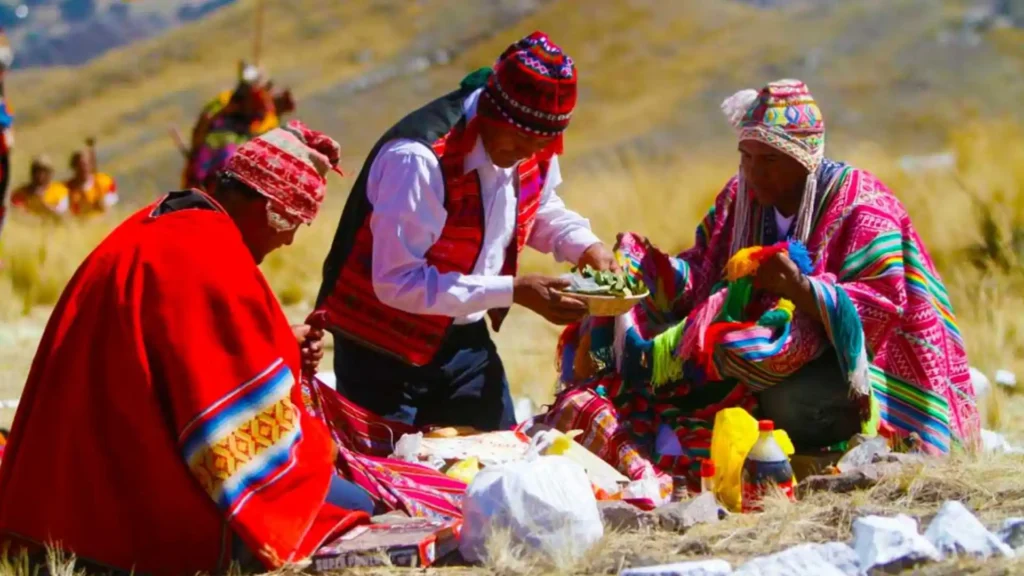
The pago a la tierra, also known as despacho, is one of the most meaningful ceremonies within Peruvian cultural traditions. In these rituals, communities make offerings to Pachamama—Mother Earth—by presenting sacred elements such as coca kintu (perfect coca leaves), chicha de jora, sweets, llama fat, and other symbolic items. These offerings are gestures of gratitude for the harvest and prayers for protection and prosperity in the future.
Guided by healers, or altomisayoq, the ceremonies are filled with chants in Quechua that create a mystical atmosphere where the sacred becomes tangible. Far from being tourist shows, these are profound acts of faith that weave people into the very essence of Andean life.
Cleansing Ceremonies
Cleansing rituals are another vital expression of Peruvian cultural traditions. During these ceremonies, healers use sacred plants like rue, rosemary, and retama to purify the spirit. The practice blends pre-Hispanic elements with Catholic influences, creating a unique form of spiritual syncretism that reflects the richness of Andean belief.
Participants are gently “cleansed” of negative energies, spiritual illnesses, or the evil eye, allowing them to restore balance between body, soul, and the Andean cosmos.
Traditional peruvian cultural practices: Ancestral art that endures
Traditional Peruvian cultural practices embrace artisanal techniques passed down through generations, keeping ancestral wisdom alive in every creation. These practices are more than just economic activities; they are living expressions of identity, memory, and connection with the past.
Ayacucho retablos
Ayacucho retablos are one of the most emblematic cultural traditions in Peru. They originated during the colonial era as a local adaptation of Spanish altarpieces. Initially called San Marcos, these small portable altars were carried by muleteers through the Andes as spiritual protection during their long journeys.
Today, entire families in Ayacucho dedicate their lives to this sacred art, crafting retablos that depict everything from the Nativity to scenes of contemporary Andean life. Each piece tells a story, sculpted with a paste of potato and plaster, then painted in vibrant colors that reflect the spiritual joy of the Andes.
Andean weaving
The art of weaving in the Peruvian Andes is among the oldest and most meaningful cultural practices. In communities like Taquile, on Lake Titicaca, weaving is more than a craft—it’s a language. Men knit chullos (traditional hats) with designs that carry family stories, while women create textiles that express the Andean worldview.
Every pattern has a purpose: stairways symbolize the path to the ancestors, diamonds represent the eyes of the gods, and colors mirror the essence of nature. These textiles are not simply garments; they are woven books of history, crafted from the wool of alpacas and vicuñas.
You may also be interested in: Top 10 things to do in Cusco for first time travelers

Cultural heritage of Peru
The cultural heritage of Peru is a living legacy that is constantly renewed while preserving its ancestral roots. Our traditions are not relics of the past displayed in museums; they are dynamic manifestations that adapt to modern times without losing their original essence.
Indigenous Languages
Quechua, Aymara, and the many Amazonian languages are a fundamental part of Peru’s cultural heritage. These languages are not just systems of communication; they are unique ways of understanding the world, of relating to nature, and of transmitting ancestral knowledge.
In Quechua, for example, there is no exact word for “time” as a linear concept. Instead, there is “pacha,” which encompasses time, space, and the universe as a single reality. This circular worldview of time explains why our traditions keep the presence of our ancestors alive in the present.
Ancestral knowledge
Traditional knowledge of natural medicine, Andean agriculture, and astronomy is part of Peru’s cultural heritage that remains deeply relevant today. Agricultural techniques such as terraces and crop rotation, developed by our ancestors, are now recognized worldwide as models of sustainable farming.
Andean healers, with their profound understanding of the medicinal properties of plants like San Pedro, ayahuasca, and hundreds of healing herbs, preserve pharmacological wisdom that modern science is only beginning to comprehend.
Conclusion on the cultural traditions in Peru
Cultural traditions in Peru are the heritage of all humanity. In an increasingly globalized world, our ancestral traditions offer alternative ways of life based on reciprocity, respect for nature, and the building of supportive communities.
Every festival, every ritual, every artistic expression is a thread in the great Peruvian cultural fabric, where the colors of the rainbow intertwine to form a unique and unrepeatable identity. We are heirs to ancient empires, but we are also creators of new traditions born from the intersection of cultures.
We invite you to be part of this cultural richness, to experience these traditions not as a spectator, but as an active participant in a heritage that belongs to all of us who love this land of contrasts and wonders. Because in Peru, every day is an opportunity to celebrate life, honor our ancestors, and build community through our cultural traditions that continue to beat strongly in the heart of the Americas.

