

The Chachapoya culture offers an equally fascinating, and often overlooked, chapter of Peru’s past. Known as the Warriors of the Clouds, the Chachapoya people thrived in the misty highlands of the Amazon region, building extraordinary cities and fortresses that still inspire awe today.
Their history is shrouded in mystery. For centuries, their achievements were overshadowed by Inca and Spanish records. But recent archaeological discoveries and growing interest in alternative travel routes have begun to reveal the brilliance of the Chachapoya culture. With towering stone walls, cliff tombs, and ceremonial traditions that reflect a deep connection to the land, the Chachapoyas left a cultural imprint that challenges what we think we know about pre-Columbian Peru.
Today, we’ll explore who the Chachapoyas were, what made their culture unique, and why their story is an essential piece of Peru’s historical mosaic.
Who Were the Chachapoya?
The Chachapoya culture flourished long before the rise of the Inca Empire. It existed from approximately 800 to 1470 AD, occupying a region of rugged cloud forests and rugged terrain in what is now the Amazon region of northern Peru. The term “Chachapoya” is believed to come from Quechua and means “People of the Clouds,” a fitting name given the altitude and mysticism of their homeland.
Spanish chroniclers described the Chachapoyas as tall, fair-skinned warriors, distinct from other Andean groups in both appearance and behavior.
Unlike other groups who were quickly absorbed, the Chachapoya culture put up a fierce resistance. They were eventually defeated and forcibly relocated by the Incas, a common strategy to weaken local identities. However, even under Inca control, the spirit of the Chachapoya people endured.
Geography played a crucial role in the formation of the Chachapoya culture. The region is characterized by steep slopes, dense forests, and high-altitude cliffs, making it naturally defensible and difficult to access.
This isolation helped the Chachapoyas develop a distinctive culture, relatively untouched by the great coastal empires. Their connection to the landscape was not only practical but also spiritual, reflected in their funerary practices, architecture, and myths.
You may also like: Shamanism in Peru: Exploring ancestral spiritual practices
Life and Traditions of the Chachapoya Culture
The daily life of the Chachapoya people reflected their harmony with the rugged landscape that surrounded them. Unlike coastal civilizations that thrived in deserts or valleys, the Chachapoyas built their lives in dense cloud forests, where every structure, custom, and belief was shaped by the environment.
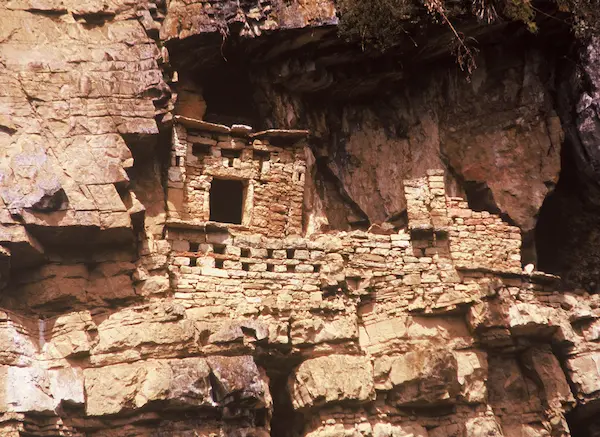
One of the most notable characteristics of the Chachapoya culture was its architecture. They built circular stone houses, often with narrow entrances and conical thatched roofs. These dwellings were clustered in small urban centers, some of which are still preserved in astonishing condition.
Most notable are their fortified cities, such as the enormous complex of Kuelap. The scale and craftsmanship of these constructions suggest a highly organized society with strong community coordination. Spiritual Beliefs and Ritual Practices
The Chachapoya culture possessed profound spiritual significance. Their funerary practices greatly reveal their view of life and death. Instead of burying the dead underground, the Chachapoya placed mummies in tombs on rocky slopes, often overlooking sacred valleys. These tombs were carefully carved into the rock, creating evocative and beautiful sites that still captivate archaeologists and travelers.
Mummification was a widespread practice, and many of the mummies have been exceptionally well preserved thanks to the dry conditions of the caves. These remains were often accompanied by pottery, tools, and other offerings, evidence of a belief in the afterlife and a connection with ancestors. The dead were not forgotten; they were honored and, in many cases, consulted through rituals.
Living in the cloud forest required ingenuity. The Chachapoyas built terraces to grow corn, potatoes, and other crops, taking advantage of the steep slopes. They also developed techniques to manage rainwater and mountain springs, ensuring year-round agriculture in a challenging environment.
Their connection with nature went beyond survival. Mountains were not just physical elements; they were sacred beings. Trees, rivers, and animals were likely part of their spiritual universe, treated with reverence and respect. This philosophy permeated every aspect of Chachapoya culture, from architecture and agriculture to funerary customs.
You may also like: Best time to travel to Peru according to each destination

Kuelap: The Great Fortress in the Clouds
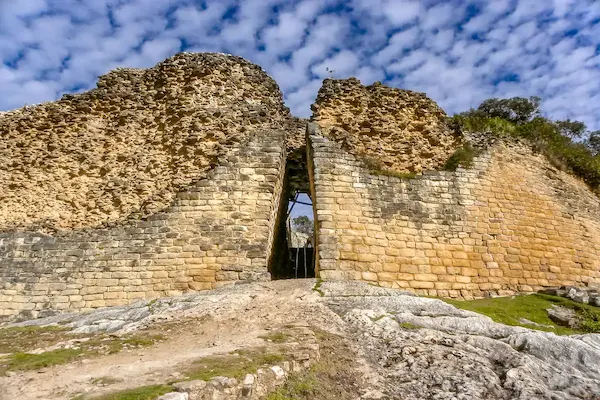
If there’s one place that captures the essence of Chachapoya culture, it’s Kuélap. Often referred to as the “Machu Picchu of the North,” this massive stone complex remains one of Peru’s most impressive archaeological sites; however, it receives only a fraction of the attention that other, more famous ruins receive.
Kuelap sits more than 3,000 meters above sea level on a towering ridge of the Andes. From a distance, it resembles a walled city emerging from the clouds, and upon closer inspection, its majesty becomes even more striking. With exterior walls up to 20 meters high, made of finely carved limestone blocks, and more than 400 circular structures within, Kuélap offers a window into the organizational and engineering skills of the Chachapoya people.
Many of the structures within its walls served as dwellings, ceremonial spaces, and tombs, indicating that it served multiple purposes: sanctuary, fortress, and government center. Although locals have always known of Kuelap’s existence, the site did not receive serious archaeological attention until the 19th century. Since then, excavations and studies have revealed an increasingly complex picture of Chachapoya culture.
One of Kuelap’s most intriguing features is its narrow entrance corridors. These were designed so that only one person could pass through at a time, making them easier to defend. Inside, the structures show evidence of social organization, ceremonial use, and even astronomical alignment.
Kuelap stands as a symbol of resilience and brilliance. In a region known for its inaccessibility, the Chachapoyas managed to create an enduring legacy carved in stone. The site challenges the idea that only the Inca Empire achieved architectural sophistication in the Andes. With the new cable car access and the growing interest in alternative tourism, more and more visitors are coming to experience this extraordinary place.
You may also like:Colonial Peru | A Deep Dive into Its History, Society, and Legacy
The Fall and Legacy of the Chachapoya Culture
No matter how resilient a civilization may be, history is often marked by conflict and conquest. For the Chachapoya people, their downfall began in the 15th century, not with the arrival of European colonizers, but with the expansionist ambitions of the Inca Empire.
The Incas, from their capital, Cusco, launched a series of military campaigns to consolidate their control over the Andean world. Their advance into the northern highlands brought them face to face with the Chachapoya culture, which was anything but passive.
Historical accounts describe the Chachapoyas as fierce warriors who resisted Inca domination with remarkable determination. It took the Incas several military campaigns to defeat them, and even then, they never achieved complete submission. This dispersal weakened their cohesion, but also spread elements of Chachapoya culture to a wider territory.
Despite their resilience, the Chachapoyas were eventually absorbed into the Inca state, contributing manpower, soldiers, and local knowledge to the empire. Some Chachapoya even participated in the Inca civil war between Atahualpa and Huáscar, aligning themselves with the side they felt best served their interests.
The arrival of the Spanish in the 16th century brought with it a devastating new wave of change. In their eagerness to dismantle Inca power, the Spanish turned to local allies, including Chachapoya groups, who had long resented Inca rule. Many Chachapoya aided the Spanish in their conquest, hoping to regain their autonomy.
But this alliance was short-lived. European diseases, cultural suppression, and the exploitation of indigenous labor systems led to a rapid decline in traditional life. Over the following decades, Chachapoya culture was further eroded by missionary campaigns and colonial restructuring.
Sacred sites were abandoned or destroyed, burial practices were disrupted, and oral histories began to fade. However, even after the collapse of civilization, its memory lived on: in ruins scattered across the mountains, in regional folklore, and in the identity of local communities.
Today, echoes of Chachapoya culture can still be found in the traditions of the Amazon region. In villages such as Chachapoyas, Levanto, and Luya, indigenous customs merge with colonial and modern influences. Local architecture, linguistic patterns, and spiritual beliefs retain vestiges of the past.
In this sense, the decline of the Chachapoya culture was never complete. Although its cities have been abandoned and its language lost, its legacy lives on in the stones of Kuelap, the misty cliffs of Karajía, and the spirit of a region recovering its roots.
Rediscovering the Cloud Warriors
The Chachapoya culture may not dominate travel brochures or history books, but its legacy is carved into the mountains of northern Peru. From the towering walls of Kuelap to the silent tombs of Karajía, their story endures mysterious, resilient, and profoundly human. Exploring their world is more than a historical journey; it’s a reminder that greatness often hides in the mist, far from the well-trodden paths.
In choosing to learn about and honor the Chachapoyas, we connect with a different rhythm of Peru ,one that values mystery, memory, and the power of place. Their culture, once nearly forgotten, now invites a new generation of travelers to listen, explore, and rediscover the richness that lies beyond the shadow of the Incas.

